Print

PTTCO Bangkok Thailand.
IWCF Drilling/Intervention Well Control
and IADC WellSHARP Certificate Training School.

What is the difference between IADC & IWCF?

Both IWCF and IADC focuses on training and testing (examination) on well control,
the consensus of regulators around the world is that either provide the required basic foundation of well control training.

For many years industry has recognised the need to train drill crews in well control and several international schemes were
developed the most wide spread being the IADC programme called WellCap (initiated and used in the USA and by many American
companies) and the IWCF assessment and certification programme (initiated in Europe).

Despite some differences, the basic goal for - and the level of training obtained by - the two systems have many similarities.
Both the IWCF and IADC basic well control programmes are sufficient for their primary target group (ie key drill crew personnel)
working on conventional wells where traditional well control methods are sufficient.

IWCF and IADC cover the industry need for a basic well control programme.

Rotary Drilling Well Control Surface
& Subsea BOP Stack Certification
Content & Syllabus
Candidate Examination Notes
Well Intervention Pressure Control
Completion, Wireline, Coiled Tubing,
Snubbing, Certification Content &
Syllabus
Candidate Examination Notes
WellSHARP Fundamental
Curriculum Outline
WellSHARP Supervisory
Curriculum Outline
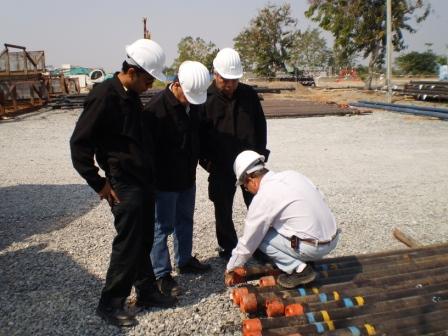
OLYMPUS DIGITAL CAMERA
Lex Lim, Petroleum Engineer for PTTCO: “How does one determine that an individual is competent and has the required skill and knowledge?
After passing a well control examination, does it indicate that an
individual has acquired the required level of competency for his or her assigned jobs?”
IWCF ROTARY DRILLING WELL CONTROL

Testing Methodology
The Certification Standards are based on a detailed analysis of the well control knowledge that Drillers
and Supervisors require, and the practical tasks that they have to master, in order to perform their jobs.
The standards have been devised so that the measurement of their skills and knowledge can be
assessed systematically. The method of assessing the performance of an individual, at both Driller and
Supervisor level, is divided into the following sections:

• A simulated practical exercise to assess practical skills
• Written test papers on Equipment and Completion Operations to assess knowledge based skills.

The certification programme comprises separate levels of tests for Drillers and Supervisors in either
Surface Stack operations or Combined Surface/Subsea Stack operations. Only one level of testing is
carried out at each session. To obtain a certificate, the candidate must achieve a minimum grade of 70%
in each of the three sections of the programme.

Practical Assessment
Each candidate is required to demonstrate his or her practical knowledge during a single well kill
assessment exercise conducted on either an electronic simulator or a pressurised training well. For
Combined Surface/Subsea candidates the simulation must utilise a Subsea well model and BOP panel.

Equipment Knowledge
The candidate is required to complete a written test paper that includes questions based on equipment
diagrams and schematics, API specifications and multiple-choice problems.

Completion Operations Knowledge
The candidate is required to complete a written test paper comprising multiple choice and direct answer
questions.
IWCF WELL INTERVENTION PRESSURE CONTROL


Well Intervention Operations: Such operations may involve co-operation between several
companies, working in wells where the conditions are only partly known and where work-
programmes may have to be developed as information becomes available during the
operations. The well control considerations, and consequently the well control training needed,
will have to be aligned with the specific conditions for the operations.


Testing Methodology
The Certification Standards are based on a detailed analysis of the pressure control knowledge required
by service equipment operators and supervisory personnel in order to perform their jobs. The standards
have been devised so that the measurement of their knowledge can be assessed systematically.
The method of assessing the knowledge of an individual is by written examination. The following
certification options are provided: -

• Coiled Tubing Operations.
• Wireline Operations.
• Snubbing Operations.

Candidates may combine two or more of the above options in a Combined Operations certification
programme. To obtain a combined certificate candidates must pass each of the operations test papers
that they sit.

The certification programme comprises separate levels of tests for Service Equipment Operators
(Level.3) and Well Intervention Supervisors (Level.4).

Equipment Knowledge
Candidates for each of the options must complete a compulsory paper on Completion Equipment
followed by specific Equipment paper(s) on their relevant discipline(s). The papers include questions
based on equipment diagrams, schematics, specifications, and application practices.

Completion Operations Knowledge
Candidates are required to complete a written test paper comprising multiple choice, well calculations,
and direct answer questions.

DRILLING  WELL CONTROL CERTIFICATION PROGRAMS
< English Language > - Bangkok, Thailand.
JUNE 2026


SU
MO
TU
WE
TH
FR
SA


 1

 2

 3

 4

 5

 6

 7

 8

 9

 10

 11

 12

 13

14

 15

 16

 17

 18

 19

 20


IWCF/IADC Drilling Well Control Training


 21

 22

23

 24

 25

 26

 27


IWCF/IADC Drilling Well Control Training


28

29

30


JULY 2026


SU
MO
TU
WE
TH
FR
SA


 1

 2

 3

 4

 5

 6

 7

 8

 9

 10

 11

 12

 13

14

 15

 16

 17

 18

 19

 20


IWCF/IADC Drilling Well Control Training


 21

 22

23

 24

 25

 26

 27


IWCF/IADC Drilling Well Control Training


28

29

30


Copyright © 2019 PTTCO Bangkok Thailand. All Rights Reserved Powered by pttco.org